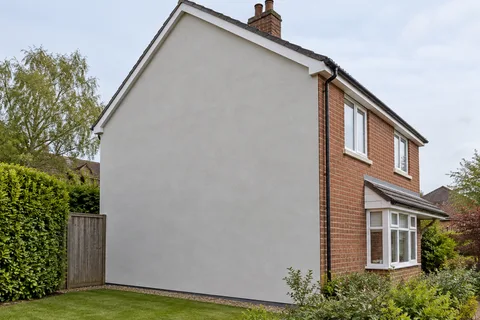
Repair the defect and understand its cause
Render repairs in Macclesfield | Cracks and failed areas
A successful render repair deals with the reason an area failed and leaves a finish suited to the surrounding wall. It is not defined solely by how well a wet patch matches on the day it is applied. In Macclesfield, repair enquiries may concern one damaged corner, repeated cracking or a larger area coming away from the background. Those situations need different scopes. The first useful distinction is between a surface defect and a problem that continues within or behind it.

On this page
Look for a pattern before selecting a repair
The position of a defect often provides useful context. Cracking at an extension junction, damage below a leaking gutter and a break beside a replaced window are not interchangeable symptoms. Photographs of the whole elevation help locate the problem; closer views show its appearance. Earlier photographs or a brief history can reveal whether it has changed or returned after a previous repair. None of these replaces inspection where the condition requires it.
Avoid assuming that the visible crack defines the full affected area. Render can lose adhesion beyond the obvious opening, while apparently alarming staining may be mostly superficial. The assessment should establish the extent and the relevant cause before deciding what to remove. If the wall itself may be moving or deteriorating, suitable professional advice takes priority over selecting a filler or coating.
| Visible symptom | Questions the assessment should resolve |
|---|---|
| Repeated crack | Movement, background changes and earlier repair history |
| Hollow or detached area | Extent of poor adhesion and condition underneath |
| Stain below a fitting | Water source and whether the finish is damaged |
| Patch around an opening | Frame, sill, seal and adjacent substrate detail |
- Map the damage Tapping finds hollow areas; cracks and their likely cause are noted.
- Cut back Failed render is cut out to a sound edge, usually squared off.
- Fix the cause Leaking gutters, sills without drips or render below the DPC are dealt with.
- Rebuild in coats Using a material compatible with the surrounding render and masonry.
- Blend the finish Texture is matched; colour may need a coating over the wider area.
The usual order of work. The survey and the chosen products decide the actual steps.
A small patch still needs a compatible material
The repair material must suit both the background and the retained finish. A particularly hard patch can create a poor relationship with softer traditional material. Conversely, a product chosen only because its colour looks similar may not be appropriate for the wall. Identify the existing system where possible and use its technical guidance; where the layers are uncertain, that uncertainty needs resolving rather than disguising beneath a generic repair product.
For older construction, lime repair and rendering guidance is relevant to the material decision. Preserving sound existing fabric may be preferable to enlarging a repair simply to make application easier. The edges need careful treatment, but there is no universal patch size or shape that suits every wall. The required extent follows condition, compatibility and the practical finishing method.
Openings deserve more than a cosmetic border
Windows and doors combine several materials and junctions in a small area. A repair beside a frame may need to address a damaged reveal, an inadequate sill projection or a failed adjoining detail. If the frame is due for replacement, coordinate that work before completing the final repair. Otherwise, a sound new edge may have to be broken out shortly afterwards.
The same principle applies to pipes and brackets. A split around a poorly fitted fixing is not resolved merely by smoothing over the hole. The attachment and its weathering detail need consideration alongside the render. Where specialist services are involved, arrange the appropriate trade. Rendering should not be used to conceal a connection that still needs access, ventilation or safe servicing.
Agree what a satisfactory visual result means
An isolated repair on an aged textured wall can remain visible even when the technical work is sound. The surrounding surface has accumulated its own weathering and may no longer match the original product reference. Grain and finishing technique also influence the result. A sample or limited trial can help establish a realistic expectation, particularly on a prominent frontage where a patch will be viewed from several distances.
If a consistent colour across the elevation is important, a compatible decorative recoating may be considered after repairs have cured and the background is suitable. That is a separate finishing decision, with its own preparation and product requirements. It should not be presented as a way to avoid repairing unsound material. In some cases, a more extensive wall refurbishment gives a clearer result than numerous disconnected patches.


Recurring failure calls for a different conversation
When the same location has failed more than once, repeating the previous treatment without further investigation is a weak basis for another contract. Assemble the dates, product information if available and photographs of the earlier work. Note whether the crack returns in the same line, whether wetting accompanies it and whether alterations occurred nearby. This history can help the assessor target the investigation without pretending to diagnose the problem remotely.
The eventual scope may include correcting a rainwater fault, revising a junction or obtaining advice on the wall itself. It may also conclude that a previous local repair was incompatible with otherwise sound material. What matters is that the proposed method responds to the findings. An explanation tied to the building is more useful than a promise that the next product is stronger.
Keep the finished work identifiable
At completion, retain photographs of the repaired areas and the material references. These need not form an elaborate dossier, but they should distinguish a lime repair from a modern system and identify any final coating. A marked elevation is helpful where several areas were treated differently. Future maintenance is easier when the next person can see what was actually done.
If repairs are one stage of a whole-house project, make their completion and inspection a distinct step before the decorative work covers them. Where coarse finishes are being removed, the pebbledash removal guide explains why additional repairs may only become apparent after controlled exposure. In either case, the repair scope should remain visible in the paperwork rather than disappearing into a broad description of preparation.
Common questions
Can a crack simply be filled and painted?
That can only be judged after its cause, condition and surrounding construction have been assessed. A cosmetic filling may be unsuitable where movement or loss of adhesion remains. Significant, changing or otherwise concerning defects may require a building professional's investigation before render repair is specified.
Why can a sound repair remain visible?
Colour, grain, finishing technique and the age of the adjoining surface all affect the match. A repair can restore a defective area without disappearing visually. Agree whether the objective is a compatible local repair, broader decorative treatment or replacement to a natural boundary before commissioning it.
See housing and planning information for Macclesfield and nearby places, including the source and geography behind each figure.