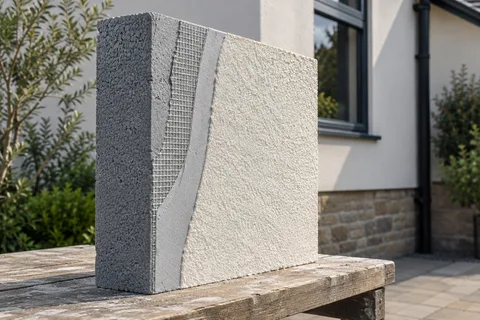
A fine finish depends on the layers beneath
Silicone rendering in Macclesfield | Finish and system
Silicone rendering is often chosen for its fine-grained appearance and wide colour choice. The visible coat is only part of the job. On a Macclesfield refurbishment, the result depends on the existing wall, the preparation beneath that coat and the treatment of every opening and edge. It is worth being precise about the proposed system: the word silicone alone does not identify the basecoat, the grain size or whether the old finish can remain.

On this page
Start with the surface that will carry the finish
A clean-looking painted wall is not necessarily a ready background. The coating may be weakly bonded, the underlying render may contain hollow areas, or older repairs may respond differently to moisture. These conditions need assessment before selecting a route over the existing surface. Preparation should be described in terms of what is found, rather than reduced to a general promise to wash the wall and apply the new finish.
New masonry has its own requirements. Its condition, dimensional accuracy and any movement joints must be considered within the selected manufacturer's system. A fine decorative texture follows the prepared plane beneath it. If the background needs correction, that work belongs in the specified earlier layers. Using the final coat as a substitute for adequate preparation is unlikely to deliver the agreed appearance.
- Sound background A background accepted by the specified system. Keeping old render requires a system-specific assessment of its bond and condition.
- Beads Corner, stop and base beads set the edges and straight lines.
- Basecoat with mesh Glass-fibre mesh embedded in the basecoat resists cracking.
- Primer Where the system requires it, tinted towards the finish colour.
- Silicone finish A thin, through-coloured, water-repellent coat that forms the texture.
Wall on the left, finish on the right. Not to scale: coats, thicknesses and primers follow the chosen manufacturer’s system and the condition of the wall.
Compare complete systems, not topcoat names
Two quotations can both describe silicone rendering and propose substantially different work. One may allow for removal and a new reinforced basecoat; another may assume that the existing render is suitable to receive a decorative treatment. The difference can be legitimate, but it must be explained. Identify the named products, preparation assumptions and the treatment of junctions before comparing the final colour.
A system specification should also address openings, movement joints and transitions to other materials. Mesh and beads have defined roles within that specification. They do not turn a moving background into a stable one or remove the need for a designed joint. Where an extension meets the original house, the connection needs attention before the two surfaces are made visually similar. The house rendering guide covers coordination across several elevations.
| Layer or stage | Information to identify |
|---|---|
| Existing background | What is retained, removed or repaired |
| Preparation and basecoat | Named compatible products and reinforcement details |
| Decorative coat | Product, grain, colour and proposed application |
| Edges and fittings | Beads, junctions, clearances and reinstatement |
View the grain at the distance you will actually see it
Small samples are useful for narrowing colours, but they can understate how texture changes a broad elevation. A finer grain may read as a relatively quiet surface from the pavement, while a coarser finish creates a more pronounced pattern nearby. The choice should relate to retained brickwork, stone details and window frames as well as personal preference. No grain size can be selected reliably from a screen image alone.
Review a physical sample in more than one light condition. A shaded side passage and a sunlit front wall can make the same colour seem different. Wet and freshly applied material may also look unlike the finished, dried sample. Agree which sample represents the contract and retain its product and colour references. A vague description such as warm white is insufficient if a later repair or extension needs to be coordinated.
Understand the alternatives before settling the finish
Monocouche rendering generally offers a different mineral, often scraped finish. The comparison is about the whole system, the background and the desired appearance, rather than a contest between two fashionable labels. A proposal for either material should say how the wall is prepared and how its edges are formed. Manufacturer suitability and the actual construction take precedence over a generic recommendation.
Where the existing textured render is serviceable and the aim is simply a new colour, render respraying or recoating may be a separate option. That still requires a compatible coating and an assessment of the existing layers. It is not equivalent to installing a new render system. Making this distinction early prevents an unnecessarily large scope on one hand, or a cosmetic treatment being mistaken for replacement on the other.


Think about rain, drying and the working sequence
Application conditions come from the named product instructions. A dry hour in the forecast does not by itself establish a suitable working window, and recently wet backgrounds may need further assessment. The programme should explain how materials, prepared surfaces and new coats will be protected, and what happens if conditions prevent the next stage. A calendar date cannot override the system's application requirements.
Large continuous faces also need sensible sequencing. The contractor should plan labour, materials and access so the intended finish can be achieved without avoidable interruptions in awkward places. Changes of plane can offer natural boundaries, whereas stopping halfway across a prominent open wall may produce an obvious visual break. Those decisions belong in the work plan before application starts.
Keep the maintenance expectation realistic
A new textured façade still needs attention to the components around it. Leaking gutters, damaged sealants, overflowing planters and poorly reinstated brackets can affect the wall even when the render itself was correctly installed. Obtain care instructions for the actual product rather than relying on a general claim that silicone requires no maintenance. Cleaning methods and any later coating should be compatible with that system.
If insulation forms part of the proposed work, the decorative finish is one component of an external wall insulation system. Its fixing, base and opening details need to be designed together. For render-only work, the same principle remains useful: choose a complete, suitable build-up and a sample you have seen in context. The final colour is the last visible decision, not the only technical one.
Common questions
Is silicone render the same as silicone paint?
No. A thin-coat textured finish and a decorative paint are different products with different purposes. The intended product should be identified by name and its place in the complete specification. Calling both a silicone finish leaves too much uncertainty about what is being supplied.
Can silicone render hide an uneven wall?
The decorative coat should not be expected to straighten the background. Any necessary levelling belongs in an appropriate preparation and basecoat specification. Light cast along the wall can make undulations particularly visible, so agree the expected surface and assessment conditions before application.
See housing and planning information for Macclesfield and nearby places, including the source and geography behind each figure.